
Somewhere south of the Ethiopian highlands, the whole mood starts changing. The sharp mountains soften into wide valleys, the air gets warmer, and paved roads quietly fade into dusty tracks that stretch across the Rift Valley floor like they’ve been there forever.
This is where the journey toward the Omo Valley usually begins.
Travel in southern Ethiopia feels nothing like the northern highlands. There aren’t grand stone monuments every day. No castle compounds sitting above towns. Less “look at this ancient building” and more “look at how people live when the landscape decides the rules.”
The region is famous for something that’s hard to package into a neat travel pitch — cultural diversity built over generations of communities living along the Omo River and across surrounding savannah. It isn’t one story. It’s many stories stacked side by side.
Within a relatively small corner of the country live dozens of ethnic groups, each with their own language, clothing, rituals, social structures, family roles, and local politics. Markets pull different communities together on specific days of the week. People arrive from far away on foot, on motorbikes, with cattle. Then suddenly a dusty village square becomes a crowded swirl of colors, beadwork, scarification patterns, metal ornaments, and shouting negotiations over goats.
It can feel surreal the first time you see it. Not in a “theme park” way. More like you’re watching an entire system you didn’t know existed.
Because villages are spread across a large territory, travel through southern Ethiopia usually follows a gradual overland route. The journey starts around the Rift Valley lakes and then drops deeper into the Omo River basin, linking towns like Arba Minch, Konso, Jinka, and Turmi as stepping stones.
Each stop adds another layer. Konso sits among terraced hillsides and stone-walled settlements that feel carefully engineered for survival. Jinka is a small gateway town — dusty, busy, half practical, half waiting room for the tribal territories around it. Further south, near Turmi, you reach communities that have lived for generations along the hotter, drier edges of the Omo basin.
For a lot of travelers this route ends up being the most memorable part of Ethiopia. Not because it’s comfortable (it’s not). Distances are long. Roads can be rough. Some days you’re just bouncing in a vehicle for hours, staring at acacia trees and wondering why you wanted “authentic travel” so badly.
And then the market day hits and you forget the discomfort. Or you visit a village and a small detail — a hairstyle, a painted face, the way someone laughs when they notice you trying to understand what’s happening — suddenly sticks in your mind for years.
Markets happen in dusty squares. People travel for hours to attend them. Herds move across dry plains while children watch from the shade of trees that somehow survive the heat. The rhythm slows down. The route becomes less about ticking off landmarks and more about observing everyday life across a region that still feels genuinely rural.
Within Ethiopia’s broader travel landscape, this southern corridor is one of the country’s main “big journeys.” Travelers who want history usually follow the Historic Route through the northern highlands. Those chasing extreme landscapes tend to head toward the volcanic desert of the Danakil Depression.
The Omo Valley journey offers something else — a cultural landscape shaped by people, not monuments.
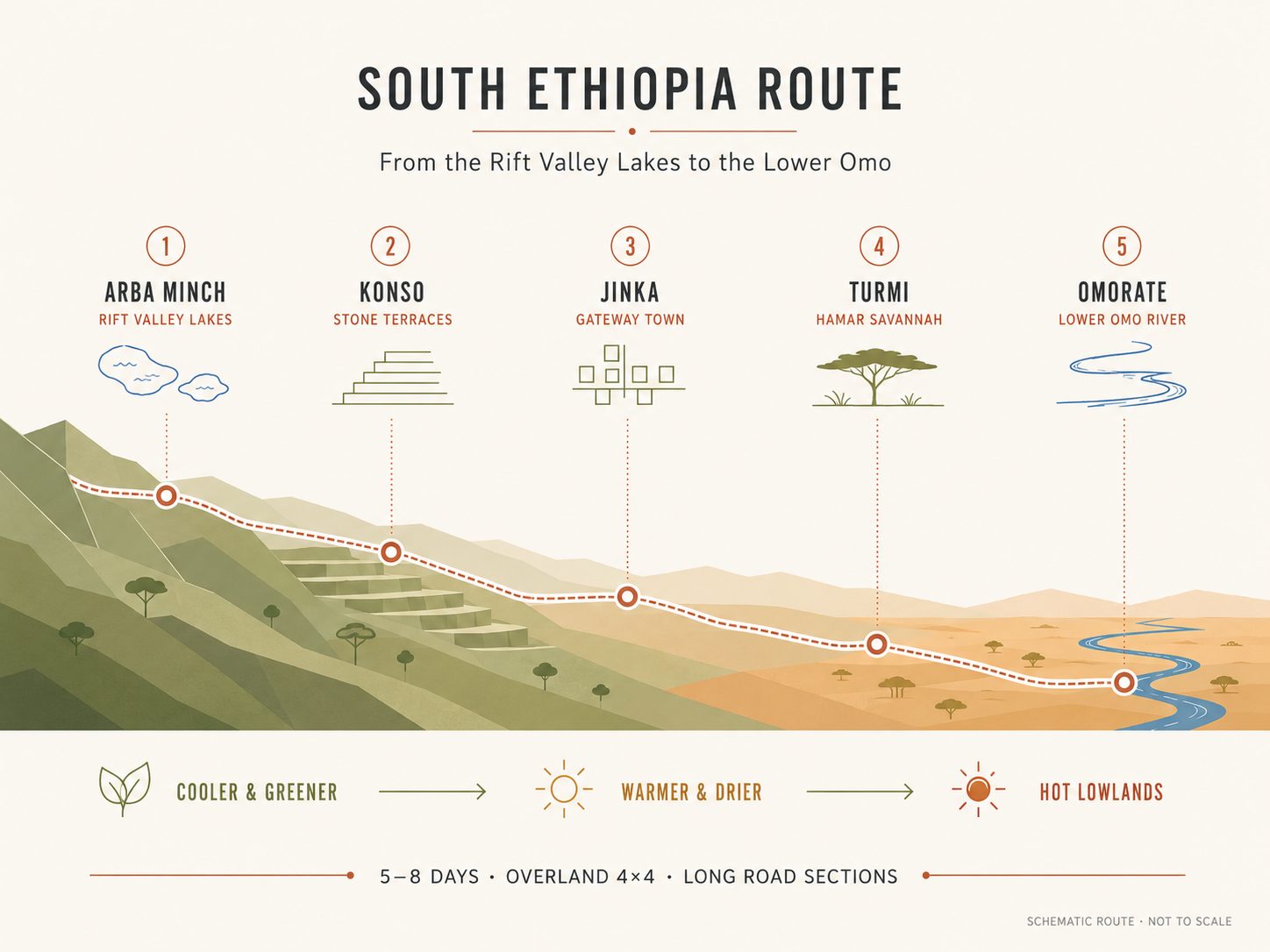
The South Ethiopia route focuses on the cultural landscapes of the Omo Valley. Travel typically follows an overland journey through the Rift Valley toward towns such as Arba Minch, Konso, Jinka and Turmi.
Along the way travelers encounter traditional markets, diverse ethnic communities and remote villages spread across the Omo River basin. Trips through the region usually last 5–8 days, depending on stops and travel pace.
Compared with the historic cities of northern Ethiopia, the Omo Valley journey emphasizes cultural encounters, rural landscapes and long road travel across the south.
Where the Omo Valley Is Located
The Omo Valley sits in the far southwest of Ethiopia, close to the Kenya border. Geographically it’s tied to the Great Rift Valley system — that long geological corridor cutting through eastern Africa like a crack in the continent.
Here the Rift opens into a broad basin shaped by the Omo River. Over centuries the river has carved out fertile valleys and seasonal floodplains that support both farming and pastoral life. Water decides a lot out here. So does timing. Rain comes, rain leaves, and people adapt around it.
Maps often label the Omo Valley as one neat region. In reality it’s huge, messy, spread out. Tribal territories overlap. National parks and wildlife zones sit next to villages. Small towns act like hubs, then suddenly you’re back in open country with nothing but scrubland and a few houses in the distance.
Most travel routes begin in Addis Ababa before moving south toward the Rift Valley lakes. From there the road pushes deeper into the region through towns like Arba Minch and Konso, then continues toward Jinka and finally the lower Omo areas around Turmi and the river basin.
Because infrastructure is limited in many areas, most travelers do this journey by four-wheel-drive vehicle. You gradually descend from cooler highlands into warmer savannah. The scenery shifts into open plains, acacia trees, dry riverbeds, occasional green pockets near water.
Even with long distances between towns, the geography creates a natural travel corridor. The South Ethiopia route tends to follow it almost by default, because there aren’t many alternative roads that make sense.
Tribal Territories of the Omo Valley
One of the reasons the Omo Valley pulls so much attention — from anthropologists, photographers, the whole curious-world crowd — is the sheer density of cultures packed into a relatively small slice of land. Across the river basin and the surrounding dry valleys, different ethnic groups developed their own rules, aesthetics, ceremonies, even their own sense of what “normal life” looks like. Livelihood matters here. Ecology matters. Old migration stories matter. And you can feel that in how villages are placed, how people dress, how they talk about land like it’s a living thing.
The Omo River sits at the center of all of it, not as a postcard feature but as a practical force. Seasonal flooding historically created fertile strips for farming along the banks, while the plains and scrubland beyond supported pastoral communities who relied on cattle, goats, sometimes sorghum when the rains behaved. Over time, different groups settled into territories that balanced access to water, grazing land, fishing spots, and trade paths. The boring word is “resources.” The real thing is survival — and pride, because people build identity around how they survive.
Today many communities still occupy the same general areas, even with modern roads, government boundaries, new administrative towns, and all the slow changes that creep in when a region gets “discovered.” Some of the old cultural geography is still visible on the ground in a way that surprises people. You drive for hours and then suddenly the visual language changes — hairstyles, beadwork, scarification, the way huts are built, the way cattle are kept. It’s not subtle.
Travelers moving through southern Ethiopia often meet these territories one after another as the road runs south from the Rift Valley lakes toward the Omo River basin. The sequence depends on the loop — Arba Minch first, maybe Konso, then down toward Jinka and Turmi — but the feeling is similar. You’re not “visiting a tribe.” You’re passing through a patchwork of homelands with their own internal logic. That phrasing matters because a lot of tourists get weird about this region, like it’s an open-air museum. It isn’t.
Even though each community has its own language and customs, the territories connect through markets, trade networks, marriage ties, and seasonal migration patterns. Livestock markets are the obvious example. Certain days bring several neighboring groups together, people arriving with cattle, goats, butter, beads, coffee, handmade tools. A market day is noisy, competitive, sometimes funny, sometimes tense. You see alliances and rivalries playing out with bargaining instead of speeches.
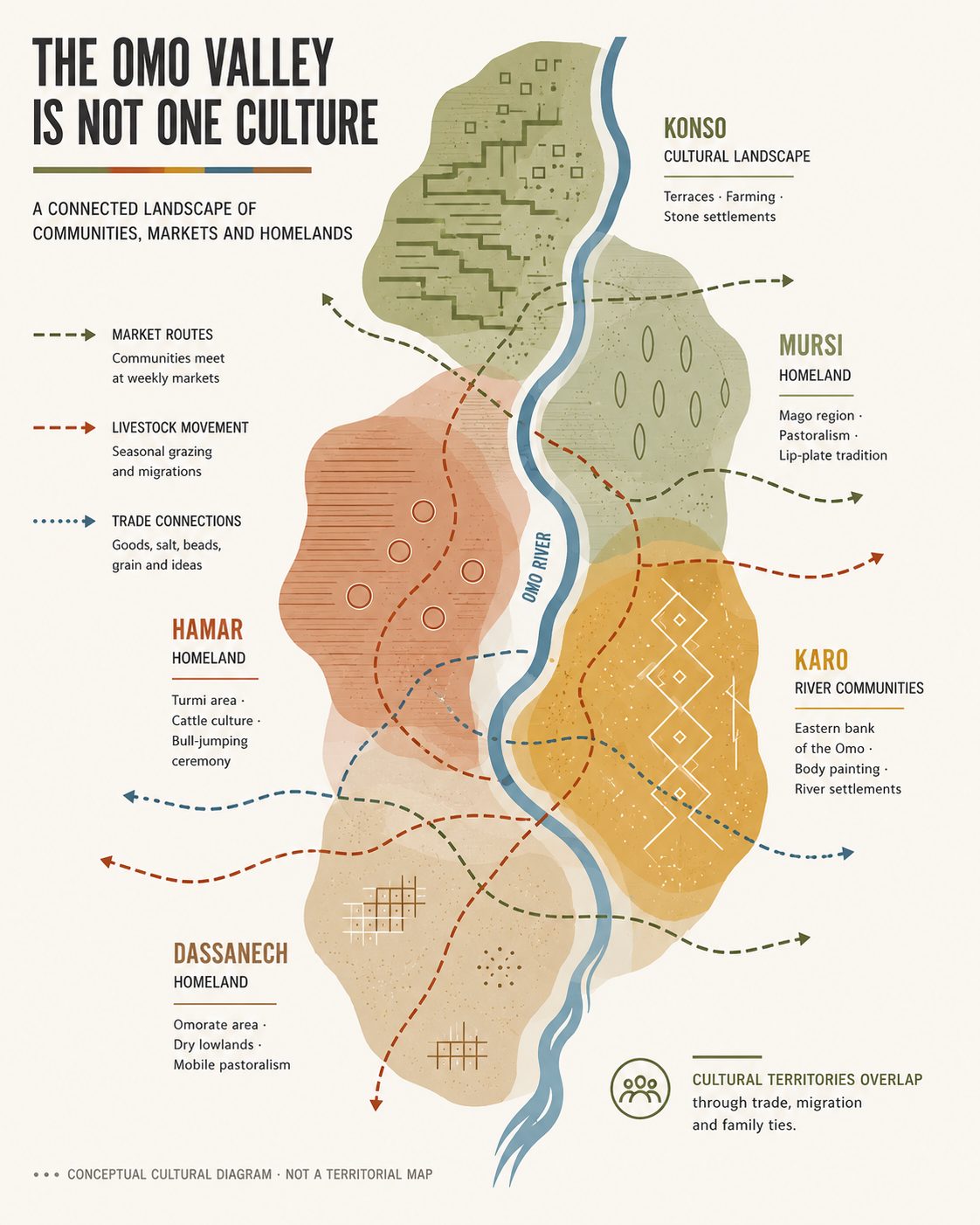
| Tribe | Main Territory | Nearby Town | Known For |
|---|---|---|---|
| Mursi | Mago National Park | Jinka | Lip plate tradition |
| Hamar | Turmi region | Turmi | Bull jumping ceremony |
| Karo | Omo River villages | Turmi | Body painting |
| Dassanech | Lower Omo River | Omorate | Pastoral desert culture |
| Konso | Konso highlands | Konso | Terraced agriculture |
The order travelers meet these territories usually depends on the route through the south. Many itineraries start around Arba Minch and the Rift Valley lakes — Lake Chamo, Lake Abaya — then push toward Konso before dropping deeper into the Omo basin. Others fly in closer to Jinka to save time, then work outward. Either way, there’s usually a gradual shift from greener highland edges into drier, hotter lowlands where cattle culture dominates the horizon.
Jinka acts as a small administrative center and logistical hub for several nearby communities. It’s where guides get supplies, where permits get discussed, where the vibe switches from “remote” to “semi-connected.” Turmi, on the other hand, feels like a gateway town — dusty, a little chaotic, built around the fact that travelers want to explore villages along the Omo River and nearby savannah settlements. If you’re hearing names like Hamar, Karo, Dassanech, Turmi tends to be where those routes branch out.
And while maps like to show neat territory blocks, the reality is more fluid. Seasonal livestock movement blurs boundaries. Market gatherings blur boundaries. Relationships blur boundaries. Even the way people talk about where they “belong” can shift depending on drought years, family ties, or who they’re trading with. A border on paper is one thing. A border in real life is… often just a stretch of land everyone understands without drawing it.
Major Tribes of the Omo Valley
Each community in the Omo Valley built its own cultural identity over a very long time. Clothing styles, hairstyles, jewelry, scarification, ceremonial rhythms — these differences make the region one of the most visually distinctive parts of Ethiopia. It’s also why people arrive with cameras first and questions second, which can be a problem. I’m not moralizing, just saying what happens.
A lot of travelers fixate on a handful of widely known groups, but the valley holds dozens of ethnic communities. Some are small, some are spread out, some are politically marginalized, some hold serious local influence. The groups below are simply among the ones most commonly encountered along the South Ethiopia travel route, especially on itineraries that loop through Jinka, Turmi, and the lower river.
Mursi
The Mursi live mainly around the territory linked to Mago National Park. They’re one of the most recognized communities in the Omo Valley, mostly because of the lip plates worn by some women — a practice that outsiders love to reduce to a single headline, as if that’s the whole story.
The plates are inserted into a pierced lower lip and can increase in size over time. Anthropologists have recorded different interpretations of the practice: cultural identity, marriage symbolism, expressions of beauty, social signaling. And honestly, the “why” isn’t always delivered as a neat explanation anyway. Sometimes it’s just “this is what we do.” People want tidy reasons. Cultures don’t always cooperate.
Traditionally the Mursi are pastoralists, relying on cattle herding plus small-scale farming in and around the river basin when conditions allow. Their villages are often in relatively remote parts of the valley, which is why many visits start from Jinka and head out early. Roads can be rough. Heat can be brutal. The landscape has that dry, wide feel that makes distances look shorter than they are.
Hamar
The Hamar live mainly around Turmi and the surrounding savannah. They’re one of the larger ethnic groups in the southern Omo region and maintain a semi-nomadic pastoral lifestyle built around cattle. Cattle aren’t just “livestock” here — they’re wealth, status, marriage currency, ritual meaning, daily conversation.
One of the most famous traditions is the bull jumping ceremony, a coming-of-age ritual for young men entering adulthood. During the ceremony, participants attempt to run across the backs of several cattle lined up side by side. It’s intense. It’s loud. People shout, sing, argue, celebrate. Visitors often stand there thinking they’re watching “a performance,” then realize the whole thing isn’t built for them at all.
Hamar women are also known for distinctive hairstyles, often treated with clay and butter mixtures that give hair a reddish tone. Bead necklaces and metal bracelets show up everywhere, sometimes layered heavily. The style is striking. The confidence is even more striking. Some travelers love it. Others feel awkward because they suddenly realize how bland their own travel clothes look. Fair.
Karo
The Karo live in small villages along the eastern banks of the Omo River. They’re one of the smaller ethnic groups in the region, but they’re widely known for elaborate body painting. This is the part that tends to show up on Instagram — painted skin, dramatic portraits, strong light — and it can flatten the reality if you’re not careful.
Using white chalk, red ochre, charcoal, and natural pigments, Karo men and women decorate their skin with geometric patterns before ceremonies or social gatherings. The designs change. They’re temporary. People improvise. Sometimes the creativity feels almost playful, like someone experimenting because they can.
Many Karo villages sit on elevated ridges above the floodplain, looking out over the river in a way that’s honestly cinematic. You stand there and the valley opens below, wide and shimmering, cattle trails cutting across the dust. Then you remember you still have to drive back on the same bumpy road, and the fantasy breaks a little.
Dassanech
Further south, near the Ethiopian–Kenyan border, live the Dassanech. Their territory stretches toward Lake Turkana and includes some of the driest, harshest landscapes in the Omo region. Wind, dust, thorn scrub, heat that makes your brain feel slow. People adapt or they leave. The Dassanech adapted.
They’re primarily pastoralists who move livestock between seasonal grazing areas depending on rainfall patterns and river access. Settlements can look more temporary than villages in other parts of the valley — structures built for movement, not permanence. That mobility is part of the culture, not a lack of “development,” which is the lazy word outsiders sometimes reach for.
Despite the environment, the Dassanech maintain strong traditions and social structures shaped by life along the lower Omo River. You see resilience everywhere, but also the pressure that comes from drought cycles, changing river systems, and border politics. It’s not just a romantic desert story. It’s complicated and sometimes harsh.
Konso
The Konso live in the highlands north of the Omo basin and represent a different cultural landscape compared with the pastoral groups further south. Their world feels more agricultural, more rooted in terraces and stonework. The air is cooler up here. The terrain folds into hills rather than flattening into savannah.
Konso communities are famous for impressive agricultural terraces built along steep hillsides. These stone terraces let farmers cultivate crops across difficult terrain while reducing soil erosion during seasonal rains. It’s functional engineering, built with patience over generations. No glossy “eco” branding, no marketing language. Just people making land workable.
The region is also known for traditional wooden statues called waka, carved to commemorate important community members. Some travelers treat them like “art objects.” Locals treat them like memory, status, lineage. Different lens.
Because Konso sits on the northern edge of the Omo travel corridor, it often becomes one of the first cultural stops on the South Ethiopia route — a kind of threshold before the journey drops into the deeper valley. And if you’re paying attention, it’s where you start noticing how fast Ethiopia can change within a single day’s drive.
Traditional Omo Valley Markets
Markets in the Omo Valley aren’t just places where people buy grain and sell goats. They’re the pulse of the region. Villages out here sit far apart — sometimes really far apart — scattered across dry plains and small river valleys. So when market day arrives, everything pulls toward that one dusty clearing where trading happens.
People start moving early. Some walk for hours across open ground carrying baskets, others drive cattle or goats along narrow tracks, kids tagging along behind. By the time the market fully wakes up the place feels completely different from the quiet countryside around it. Color everywhere. Fabric, beads, woven baskets, sacks of sorghum, small piles of spices laid directly on the ground. Animals bleating in every direction.
Honestly, if someone wants to understand the cultural patchwork of southern Ethiopia, the easiest way is just to stand in one of these markets for a while and watch. Different communities drift in from surrounding villages. You see it immediately in the clothing — beadwork styles, hairstyles, ornaments, the way people carry themselves. One group arrives, then another, and suddenly the market becomes this collision of traditions that normally live miles apart.
Trade still sits at the center of it all. Livestock deals happen constantly. Goats change hands, cattle get inspected like used cars, chickens flap around in woven baskets. Farmers bring grain, honey, butter wrapped in leaves, tobacco bundles, handmade tools. Some markets lean heavier toward animals, others toward crops grown in the fertile valleys around the Omo River.
Timing matters a lot here. Every market runs on its own weekly schedule, which means travel plans across the Omo Valley often bend around that calendar. Guides quietly rearrange routes so visitors arrive on the right day, otherwise you end up standing in an empty field wondering where everyone went.
| Market | Location | Market Day | Communities Often Present |
|---|---|---|---|
| Key Afer | Near Jinka | Thursday | Banna, Ari, Hamar |
| Dimeka | Near Turmi | Saturday | Hamar, Banna |
| Turmi Market | Turmi | Monday | Hamar communities |
| Jinka Market | Jinka | Tuesday | Ari, Mursi traders |
Some markets feel bigger, louder, a bit more chaotic. Dimeka is one of those. The place fills with traders from several communities at once and the crowd spreads across the entire field. Key Afer has its own rhythm too — colorful bead necklaces laid out on cloth, metal tools stacked beside grain sacks, livestock wandering right through the middle of the crowd like they own the place.
These aren’t structured marketplaces with stalls and signs. People sit under acacia trees, or under rough wooden frames covered with fabric. Negotiations happen quietly at first, then suddenly louder when someone thinks the price should be lower. Goods arrive the old way — carried by foot, loaded onto donkeys, sometimes strapped to motorcycles that look barely capable of surviving the dirt roads leading into town.
And markets double as social events. People meet relatives they haven’t seen for weeks. News spreads. Conversations stretch out under tree shade while livestock wander nearby. If you stay long enough the trading fades into the background and what you’re really watching is community life happening in public.
Ceremonies and Cultural Traditions
Markets show daily life. Ceremonies reveal another side of the Omo Valley — the moments when communities gather for something bigger than trade or routine work. These events carry layers of meaning tied to identity, age, status, memory. Outsiders don’t always see them during a short trip, and honestly that’s normal. They happen when they happen.
Still, knowing about them helps explain a lot of the cultural atmosphere travelers notice while moving through the region.
Bull Jumping Ceremony
Among the Hamar community, one ceremony stands out because it marks the passage from youth into adulthood. The bull jumping ritual. It’s intense, loud, emotional — the kind of event that pulls entire villages together.
During the ceremony a line of cattle stands shoulder to shoulder while the young man about to enter adulthood runs across their backs. Several times. Barefoot, balancing, trying not to fall. The crowd watches closely because the outcome matters. Completing the run means he’s ready to start adult life — marriage, responsibility, his own household within the community.
But the ceremony isn’t only about the jump itself. Families travel long distances to attend. Food is prepared, livestock slaughtered, gifts exchanged. Singing begins early and dancing carries on through the day. Dust rises from the ground as people gather around the central space where everything unfolds.
Body Painting Traditions
The Karo people approach decoration differently. Body painting forms part of their cultural expression, almost like a moving canvas. Chalk, ash, crushed minerals, natural pigments — whatever is available — becomes material for patterns drawn directly onto skin.
Some designs appear before celebrations or gatherings, others seem spontaneous. Geometric lines across arms and shoulders, dots along the chest, sweeping curves that follow the shape of muscles. The pigments wash away eventually, which means the designs change constantly. Temporary art, basically.
Lip Plate Tradition
Then there’s the lip plate tradition most people associate with the Mursi community. Visitors often recognize it instantly because photographs of Mursi women wearing clay plates have circulated widely for decades.
Young women may begin wearing these plates inserted into the lower lip as part of cultural identity within the community. The practice carries layers of meaning depending on who you ask. Some people link it to ideas of beauty and maturity. Others connect it to social identity or historical traditions passed through generations.
Interpretations vary. The symbol remains powerful though, and within the Mursi community the tradition continues to hold cultural weight.
Photography happens often during visits to villages and markets across the Omo Valley, but asking permission matters. In many communities a photograph isn’t just a casual snapshot — it’s part of an interaction between visitor and local residents, and that interaction carries expectations of respect.
Curiosity helps. Respect helps even more. Cultural encounters here feel richer when travelers slow down, observe quietly for a moment, and treat people not as attractions but as neighbors sharing a landscape that has been home for generations.
Typical South Ethiopia Travel Route
Travel through the Omo Valley almost never follows a straight line. Roads bend around hills, dip into dry riverbeds, wander through small settlements that barely show up on maps. The route slowly drifts south from the Ethiopian highlands toward the Omo River basin, and somewhere along the way the landscapes start shifting in small but noticeable ways.
The air warms. Trees thin out. Villages become more scattered.
Most journeys start in Addis Ababa before dropping toward the Rift Valley lakes. From there the road continues deeper into southern Ethiopia where a chain of small towns acts like stepping stones across a huge rural region.
Exact itineraries vary — flights change things, road conditions change things, guides sometimes improvise based on market days — but most travelers end up following roughly the same sequence of stops. Each one breaks up the long distances and opens a small window into another local culture.
-
Addis Ababa → Arba Minch
The trip south usually begins with either a long overland drive or a short domestic flight to Arba Minch. The town sits on a ridge above two Rift Valley lakes — Lake Abaya and Lake Chamo — and serves as a natural northern entry point to the Omo Valley route. It’s also one of the greener places along the journey. Crocodiles live in Lake Chamo, fishermen head out before sunrise, and the air feels noticeably softer than the dry lowlands further south. -
Arba Minch → Konso
From Arba Minch the road moves toward the Konso highlands. The scenery changes quickly here. Hillsides are cut into stone terraces that have supported agriculture for generations, maybe centuries. Konso villages are built from stone and wood, often sitting on ridges overlooking farmland. Walking through them feels organized, almost engineered, like every wall and pathway exists for a reason. -
Konso → Jinka
Further south the environment shifts again. The land grows warmer and drier as the road approaches Jinka, a small but busy town that functions as a logistical hub for the surrounding tribal territories. Travelers pass through here before visiting communities living near Mago National Park. Jinka itself is part frontier outpost, part supply stop — dusty streets, fuel stations, guides negotiating transport, trucks rattling through town. -
Jinka → Turmi
Driving deeper into the valley brings you to Turmi, a small settlement surrounded by open savannah landscapes. The place feels quiet at first glance, though market days transform the town into something much louder and more colorful. Turmi often acts as a base for visiting nearby Hamar and Karo communities whose villages lie across the surrounding plains and river valleys. -
Turmi → Omorate
Some itineraries continue even further south toward Omorate near the Kenyan border. Here travelers cross the Omo River by local boat to reach Dassanech communities living along the riverbanks. The crossing itself is simple — wooden boats, slow current, a few goats occasionally joining the ride — but stepping onto the other side suddenly places you in a landscape that feels even more remote than the road behind you.
Distances between towns can be deceptive. A line on the map might look short, then the drive stretches into several hours of dust, bends, cattle crossings, and occasional roadside conversations with curious locals.
The slower pace is part of the journey though. Landscapes gradually change. Cultural details appear one by one instead of all at once.
Travel Logistics in Southern Ethiopia
Logistics in the Omo Valley operate differently from northern Ethiopia. The Historic Route relies heavily on domestic flights between cities. Down here the road does most of the work.
Southern Ethiopia has seen infrastructure improvements over the years, but long rural stretches remain common. Paved sections connect major towns, then suddenly the asphalt disappears and the vehicle rolls onto gravel or packed earth.
Because of this, four-wheel-drive vehicles are standard for most itineraries. Not because every road is terrible — many are perfectly manageable — but because side trips to villages and markets often leave the main highway entirely.
Distances can look small on paper. Reality tends to stretch them out. A journey of around 150 kilometers might quietly turn into three or four hours of driving depending on terrain, road condition, or the occasional herd of goats blocking the road.
Accommodation varies along the route. Larger towns like Arba Minch and Jinka offer a handful of lodges and small hotels with decent comfort. Further south, places like Turmi lean toward simpler guesthouses used mainly by travelers exploring nearby villages.
Still, the route remains accessible as long as itineraries allow time for the road. Trying to rush through southern Ethiopia usually backfires. The region moves slower than travel plans often expect.
| Route Segment | Distance | Typical Travel Time |
|---|---|---|
| Addis Ababa → Arba Minch | ≈ 450 km | 1 hour flight or 7–8 hours drive |
| Arba Minch → Konso | ≈ 90 km | 2 hours |
| Konso → Jinka | ≈ 115 km | 3–4 hours |
| Jinka → Turmi | ≈ 125 km | 3–4 hours |
| Turmi → Omorate | ≈ 70 km | 1–2 hours |
Some travelers shorten the long first leg by flying between Addis Ababa and Arba Minch or Jinka. From there the rest of the journey continues overland through the valley.
Compared with the Historic Route in northern Ethiopia, the Omo Valley trip involves more hours on the road. But that road is where most of the experience happens anyway — landscapes shifting slowly, villages appearing without warning, markets erupting into noise in places that looked completely quiet the day before.
Accommodation in the Omo Valley
Accommodation in southern Ethiopia is usually simpler than what you’ll find up north in the historic highland cities. The Omo Valley is still remote in a very real, practical way — not “remote” like a marketing line, remote like: limited supply runs, patchy infrastructure, towns that exist because they’re market centers or administrative points, not because they’re trying to charm travelers.
Still, you won’t be sleeping on bare ground unless you choose to. Along the South Ethiopia route there’s a range of places to stay, it just isn’t the glossy kind of range. Larger towns like Arba Minch and Jinka tend to have the most comfortable options — proper lodges, a bit of choice, sometimes even a decent restaurant attached. Smaller places like Turmi usually mean basic guesthouses or small lodges built for people passing through to villages and markets nearby. Think functional rooms, simple bathrooms, and the kind of nights where you hear the whole town settle down.
In recent years a handful of eco-lodges and “nature” properties have popped up in different corners of the region. Some are genuinely thoughtful — built to blend into the landscape, using local materials, keeping things low-key. Others slap the eco label on because it sells. Either way, the vibe is usually quiet, outdoorsy, and a little raw around the edges, which honestly suits the south more than polished hotels ever could.
Facilities vary wildly from town to town. Electricity might be stable in one lodge and completely erratic in the next. Hot water might exist in theory, then vanish the second you actually need it. Wi-Fi is sometimes a joke, sometimes weirdly fine, usually in short bursts that make you irrationally happy. In more remote areas, expect simpler conditions and don’t treat that as a “problem” you need to solve. For a lot of travelers it becomes part of the texture of the trip — early mornings, dusty shoes, bucket showers, candlelight dinners when the power drops.
| Town | Accommodation Type | Comfort Level |
|---|---|---|
| Arba Minch | Lakeside lodges and hotels | Moderate to comfortable |
| Konso | Small lodges and eco camps | Simple but comfortable |
| Jinka | Guesthouses and local lodges | Basic to moderate |
| Turmi | Small lodges and camps | Basic |
People who care a lot about comfort often build the trip around a couple of stronger bases — more nights in Arba Minch, more nights in Jinka — then do day trips out to villages or markets and come back to a hot shower and a bed that doesn’t feel like it’s made of plywood. Others do the opposite and stay closer to the action, closer to villages, because the valley gets quiet at night in a way cities never do. After the market crowds leave and the vehicles disappear, you suddenly hear insects, distant cattle bells, wind moving through thorn trees. It can feel almost hypnotic.
There’s also the practical side nobody loves talking about: sometimes the “best” accommodation choice is just the one that works with the route. If you’re driving long days, arriving late, leaving early, you don’t want the extra friction of hunting for the perfect lodge. You want reliable, clean enough, and a place that won’t derail the next morning.
Travel Difficulty and Conditions
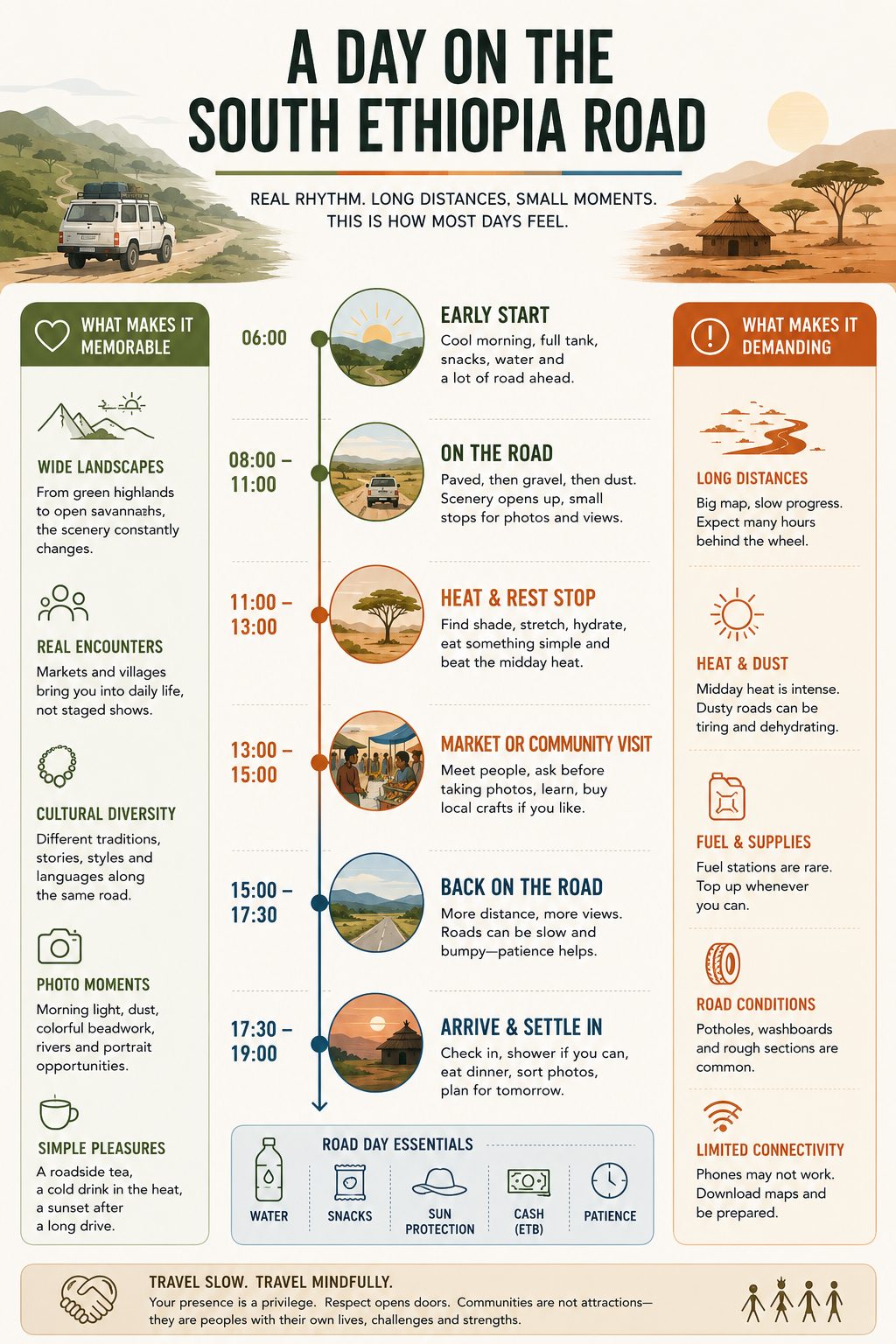
Exploring the Omo Valley requires a different mindset than visiting major cities or historic monuments. It’s not hard in an extreme-adventure way, but it is demanding in a slow, cumulative way. The region covers a wide area and travel means long distances across rural landscapes, with the kind of driving that drains you without you noticing until you stop.
Road conditions depend on season and on luck. The main highways between larger towns are generally paved, so you’ll have stretches that feel almost easy. Then you turn off toward villages and it becomes dirt tracks, corrugations, dust clouds, occasional washouts. In the dry months everything is powdery and the vehicle is permanently coated. When rain hits, some of those tracks become mud — the sticky kind — and what was a two-hour drive can turn into “we’ll see when we get there.”
Heat is another factor people notice fast. The Omo Valley sits at lower elevation than the northern highlands, and the daytime temperatures can feel heavy, especially in the southern sections near the lower river. You can drink water constantly and still feel like you’re behind. Shade matters. Midday breaks matter. A lot of itineraries look reasonable on paper until you remember you’re doing them in sun that doesn’t mess around.
The good news is: most travelers find the route manageable when the itinerary isn’t rushed. Time is the real comfort upgrade here. Guided trips help because experienced drivers know which roads are realistic, where the fuel stops are, which routes turn ugly after rain. A guide who actually knows the region also saves you from wasting energy on small logistical fights, which is a gift.
| Factor | Difficulty Level | Notes |
|---|---|---|
| Road Conditions | Moderate | Mix of paved roads and rural tracks |
| Distances | Moderate | Long travel days between towns |
| Heat | Moderate | Warmer than northern highlands |
| Infrastructure | Basic | Limited facilities in remote villages |
One more thing people don’t always expect: “difficulty” isn’t only physical. It can be sensory. Dust in your hair. The constant jolt of rough roads. The way your schedule depends on market days and road conditions rather than your preferences. Some people thrive on that. Others get annoyed and then feel guilty for being annoyed. Both reactions are normal.
Responsible Travel in the Omo Valley
Travel in the Omo Valley involves direct encounters with communities that still hold strong cultural traditions. For many visitors these moments feel intense — fascinating, uncomfortable, moving, sometimes all at once. And yes, it raises questions about respectful tourism, because you’re not looking at monuments. You’re meeting people.
Village visits, markets, and photography often involve an exchange between travelers and residents. In many places people expect a small payment for photos, or for participating in cultural activities, or sometimes simply for the time and attention involved. These arrangements developed over years as tourism increased. They can feel transactional if you arrive expecting “authenticity” served up for free. They can also feel fair if you remember that you’re the one who came with money, cameras, curiosity, and the ability to leave whenever you want.
Approaching these encounters with respect and openness matters more than having the “perfect” ethical framework. Ask before photographing people. Don’t sneak shots. Don’t treat someone’s face like scenery. Follow local guidance from your guide, especially in sensitive situations. And if you feel awkward… good. That awkwardness is sometimes your brain realizing this isn’t a theme park.
Always ask before photographing people, follow your guide’s advice during village visits, and treat local customs with curiosity and respect. Cultural encounters in the Omo Valley work best when they remain genuine exchanges rather than staged experiences.
Responsible travel also plays into something bigger: cultural control. Many communities see tourism as an opportunity — money, visibility, a chance to share traditions — but they also want to maintain power over how visitors interact with their villages and markets. When travelers ignore rules, push boundaries, or behave like they’re entitled to access, it doesn’t just ruin a moment. It shifts the whole atmosphere. It turns curiosity into suspicion. Nobody wins.
And honestly, the simplest rule is this: treat people like people, not like a checklist item. If you do that, most of the rest tends to fall into place.
Best Time to Visit the Omo Valley
You can visit the Omo Valley most of the year, and plenty of people do. The difference is how it feels when you’re there. Weather in southern Ethiopia doesn’t just decide if you’ll sweat more or less — it shapes the roads, the market energy, even the pace of village life in a way travelers notice fast.
This isn’t the Ethiopian highlands with crisp mornings and jackets at night. The Omo sits lower, warmer, a bit heavier in the air. Temperatures stay fairly steady across the months, but rain is the wildcard. When the rains come, the valley changes in a real, physical way. Dust turns to mud. Tracks become rivers. A drive that looks short on Google Maps turns into a slow crawl behind a truck that’s also stuck, because of course it is.
The driest stretch — roughly November through March — is usually the easiest time to move around. Roads are more reliable, travel days feel smoother, and you’re less likely to lose an afternoon to a muddy detour. Markets tend to be lively in this period too, not because people suddenly become more social, but because movement is easier. Traders show up, livestock gets brought in, the whole thing feels louder and fuller. The savannah stays open and accessible for overland routes between towns like Jinka, Turmi, Konso, and Arba Minch.
Rainier months shift the whole vibe. April to June is often the main wet stretch in the south, and October can bring a shorter burst of showers. Sometimes it’s just quick rain. Other times it’s the kind of rain that turns unpaved roads into thick clay and makes the “drive time” estimates feel like a joke someone told you earlier. Travel still happens, but it can be slower, and you need more patience for unexpected delays. A lot more.
Still, the green season has its own appeal. The valley gets softer. Dry plains pick up color, the air smells different, and you see more farming activity — fields being worked, water flowing in places that were dusty a month earlier, animals looking healthier because grazing improves. Photographers love this period because the landscape stops looking harsh and starts looking alive, almost lush in parts. And you get fewer tourists, which can make markets and village visits feel less like a performance.
| Season | Months | Travel Conditions |
|---|---|---|
| Dry Season | November – March | Best road conditions and comfortable travel |
| Green Season | April – June | Greener landscapes but occasional muddy roads |
| Short Rains | October | Short showers possible but still manageable |
Pros and Cons of the South Ethiopia Route
The South Ethiopia route hits totally different from the Historic Route up north. No castles. No carved stone churches tucked into mountain towns. Down here it’s about people, markets, rivers, dry plains, and those long drives where you stare out the window thinking “there’s nothing here” and then five minutes later you pass a village that feels like an entire world of its own.
For a lot of travelers it ends up being the part of Ethiopia that sticks hardest in the memory. Not always in a comfortable way. Sometimes in a “I can’t stop thinking about what I saw” way. And yeah, it can be exhausting. Towns are far apart, infrastructure is basic once you leave the bigger centers, and travel days can get long fast. The valley doesn’t care if you had a good night’s sleep.
- Unique cultural diversity across multiple ethnic communities
- Vibrant weekly markets and traditional gatherings
- Dramatic Rift Valley landscapes and rural villages
- Opportunity to observe traditions rarely seen elsewhere
- Less visited than northern historic sites
- Long travel distances between towns
- Basic accommodation in remote areas
- Hotter climate compared to northern Ethiopia
- Road conditions can vary depending on the season
Frequently Asked Questions
How many days do you need to visit the Omo Valley?
Is the Omo Valley safe to visit?
Can you travel independently in the Omo Valley?
Can the Omo Valley be combined with other Ethiopia routes?
The South Ethiopia route drops you into one of the most culturally layered regions on the continent. Markets along the way, villages near the Omo River, long stretches of Rift Valley landscape — it all feels built on centuries of adaptation, tradition, and daily life that keeps moving whether tourists show up or not.
If you’re willing to slow down and just watch what’s happening — the way people trade, gather, travel, talk — the Omo Valley can get under your skin a little. In a good way. Sometimes in a complicated way. But it rarely leaves people indifferent.